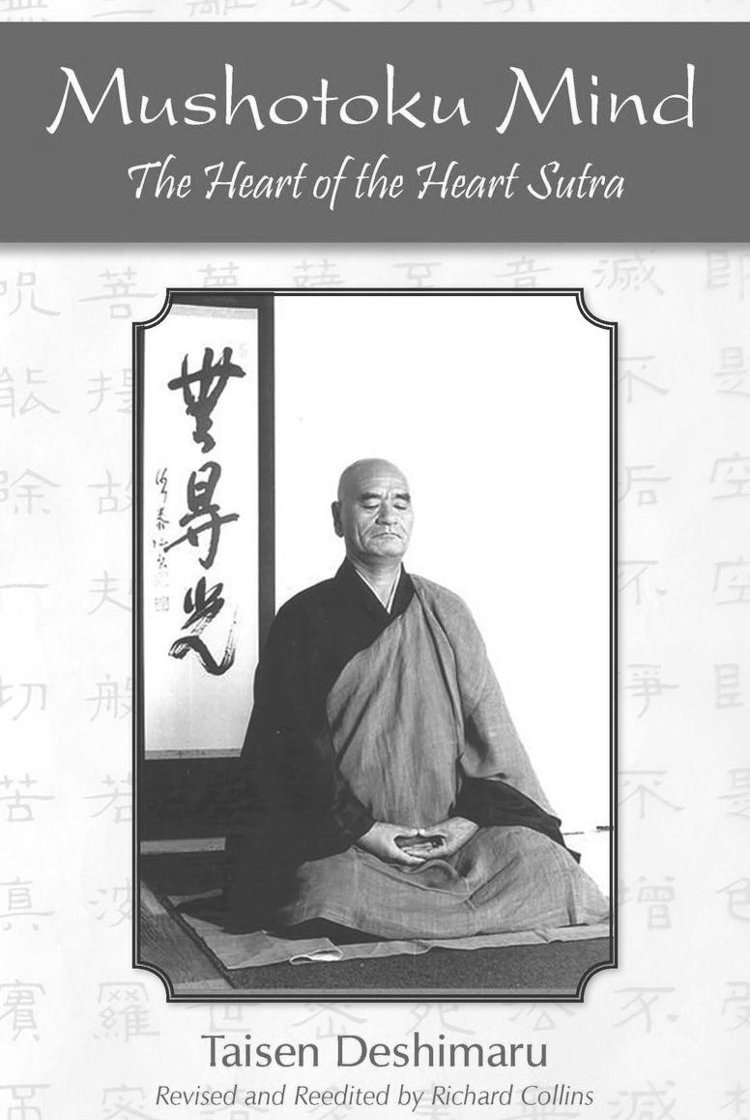
Mushotoku means without profit and without gain, and it is the single idea Deshimaru returned to more often than any other. This book is his commentary on the Heart Sutra, the text chanted daily in Zen temples worldwide and in every dojo he founded, organised around that one word.
Hohm Press published it in 2012, at 176 pages. The route it took to print says something about how his teaching has been transmitted: lectures given in French and English, translated by Ilsa Fatt, edited by Reiryu Philippe Coupey working with his British and French groups, then revised and re-edited for American readers by Reishin Richard Collins, a Zen teacher in Deshimaru's lineage and abbot of the New Orleans Zen Temple, who also supplies the introduction. Collins is the one who describes mushotoku as the heart of the Heart Sutra, and the phrase fits the book.
The Hannya Shingyo is a short text that uses the full analytical apparatus of Buddhist philosophy to argue that the apparatus does not finally reach anything. Deshimaru enjoys that paradox and refuses to resolve it. His reading keeps circling back: the way of the Buddha is mushotoku, the way of the bodhisattva is mushotoku, zazen is mushotoku, and every teaching is mushotoku or it is not a teaching.
What he means is uncomfortable in a way that has only become more so. Sitting in order to get something cancels the sitting. Not as a moral failing, but structurally, in the way that trying to fall asleep keeps you awake. The aim is the obstacle. Much of the book is Deshimaru finding new angles on this, because it is a point almost nobody accepts on first hearing.
His emphasis falls on ku, usually rendered as emptiness, and this is where the book has become unexpectedly topical. Meditation reached the West's general public largely as attention training with measurable benefits: less stress, better focus, improved sleep. Deshimaru's Zen starts from the opposite premise, and the contrast is sharp enough that reading him now feels almost polemical, though he died decades before the industry existed.
He argues the point through ordinary experience rather than doctrine. The affections people value most, for a family or a place, are valued precisely because they are not transactional, and they cannot be produced by deciding to have them. They arrive when expectation is dropped. That, he suggests, is mushotoku mind already operating in a life, recognised under another name.
The commentary carries the marks of where it was made: a Japanese teacher formed in Soto monasticism, working out how to say this to Parisian students in the 1960s and 70s who had read a great deal of philosophy and were inclined to treat Zen as more of it.
For readers who have heard the Hannya Shingyo chanted, in the films on this site or in a dojo, this is the book that explains what the room is saying.