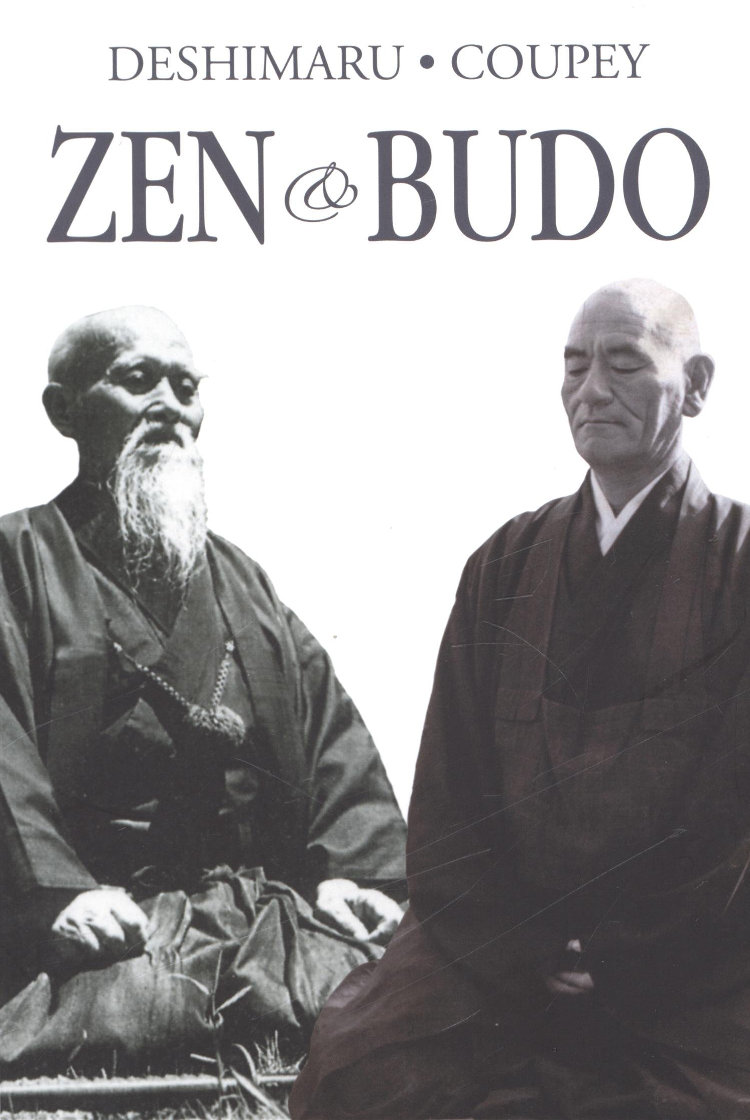
A single lecture, given in Switzerland in 1975, published by Budo Editions in Paris in 2014 as a bilingual volume of 157 pages with English and French on facing pages.
Its subject is the kinship between Zen and budo. Both, in Deshimaru's account, are ways of waking the mind up, and both dissolve the gap people assume exists between sitting still and moving. He traces the historical filiation, how Zen entered the training halls of Japan and what it left there, and then presses on the part that matters to him: what happens to attention, breathing and fear when the two disciplines are practised as one thing rather than two.
Because it is a lecture rather than a compilation, it holds a single line of thought from beginning to end. That makes it the most approachable of his martial arts writings, and a reasonable first book for someone who trains in kendo, aikido, judo or karate and has begun to suspect there is something underneath the technique they are being taught.
The book has a second claim on attention. This was the first text Philippe Coupey worked on with Deshimaru, which makes it the beginning of a collaboration that produced several further volumes and much of what exists of Deshimaru's teaching in print. Coupey had met him in Paris three years earlier and had studied literature at the Sorbonne; the working relationship that started here ran until Deshimaru's death in 1982 and continued afterwards through decades of editing. Anyone interested in how an oral teaching became a body of books can treat this as the first page of that story.
The bilingual layout is a practical virtue rather than a gimmick. The two languages sit opposite each other rather than interleaved, so neither interferes with reading the other, and a reader with French can check what a passage sounded like before translation. For a teacher who worked constantly across languages, and whose meaning sometimes depended on which language he had reached for, that is more than a convenience.
It is also the shortest way into a theme that runs through everything else on this site. The Desjardins films devote much of their second part to kendo, aikido and the argument that martial arts rooted in Zen are a training in peace rather than aggression. Deshimaru makes the same case here directly, in his own words, in a form you can read in an evening.
For practitioners, the useful thing is that he does not flatter. He is not offering a philosophy to decorate training with. He is claiming that without the sitting, the training goes somewhere else entirely, usually towards sport and the desire to win, and that the desire to win is the specific thing budo was designed to dismantle.