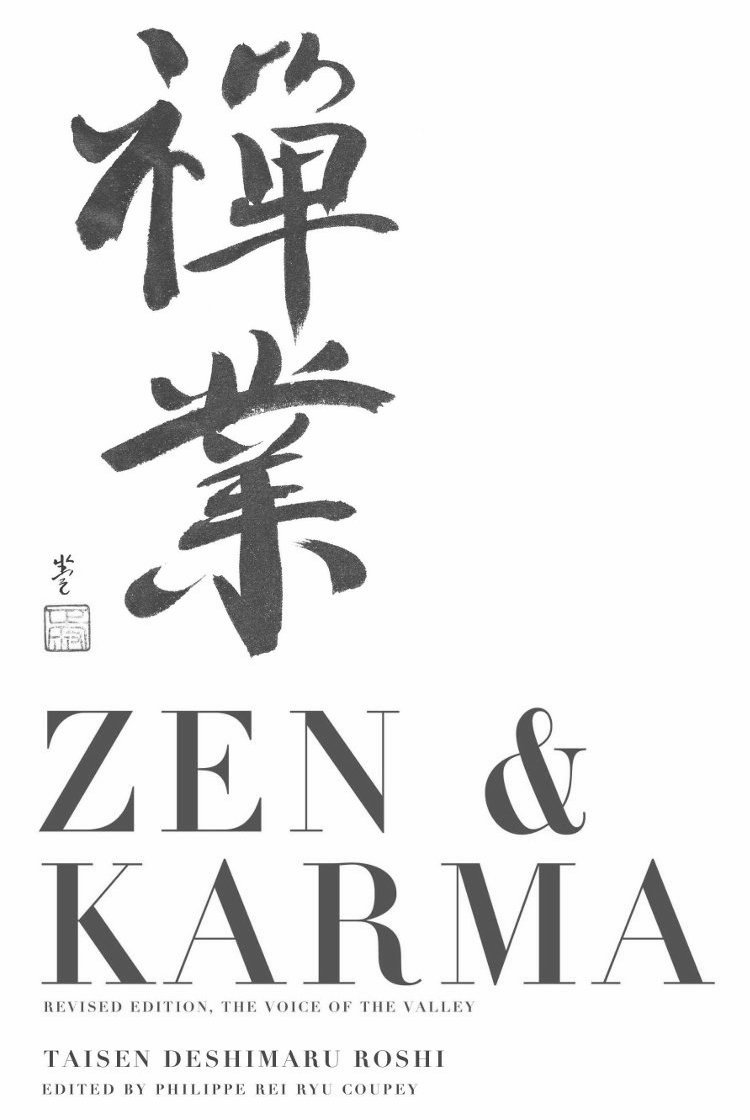
Karma is everywhere in Indian Buddhism and almost absent from Zen teaching, which tends to leave the subject to other schools and get back to the cushion. This book is the exception, and that alone makes it unusual in the literature.
It began life in 1979 as The Voice of the Valley, published by Bobbs-Merrill. Hohm Press issued it again in 2016 under the title Zen & Karma, fully revised by its editor, Philippe Rei Ryu Coupey, who had taken the original notes. Coupey, a New Yorker who moved to France in 1968 and met Deshimaru in Paris in 1972, went on to edit several of his books and now teaches in his lineage.
The material comes from a multi-day sesshin. What Deshimaru gave during those retreats was kusen, the teaching a master speaks aloud while the room sits zazen, which means the text has the rhythm of speech rather than the shape of an essay. He was speaking English, a language he used with more energy than accuracy, and Coupey and other students wrote down what they heard. The result keeps the improvisation, the repetitions and the sudden swerves.
The title is not decorative. It comes from the Dogen theme of the sound of the valley and the colour of the mountains understood as the voice and body of the Buddha, and it points at the same time to Val d'Isère, the alpine village where Deshimaru held his long summer camps and whose name is literally the valley of the Isère.
On the subject itself, Deshimaru moves the question off the ground most readers expect. Karma in popular usage is a private balance sheet, a record of what you have done coming back to meet you. He treats that framing as beside the point. What concerns him is the activity of humanity as a whole, the continuous collective consequence of how people think and act, in which any individual life is already embedded before it makes a single choice. Thinking is not a preliminary to action in this account; it is action, and it produces effects immediately. The hell people find themselves in is, in his reading, one they are generating in the present tense.
The remedy he proposes is not moral accounting. It is clearer perception, and the access to it is sitting. That is where the book connects back to everything else he taught, and why it does not read as a doctrinal excursion.
Its tone is worth flagging. This is teaching from the late 1970s, given to people who had committed weeks of their summer to it, and it makes no concessions to comfort. Anyone arriving from contemporary wellness meditation will find it stark. Anyone who has read the shorter books and wondered what Deshimaru sounded like over several days with a room that was not going anywhere will find the answer here.