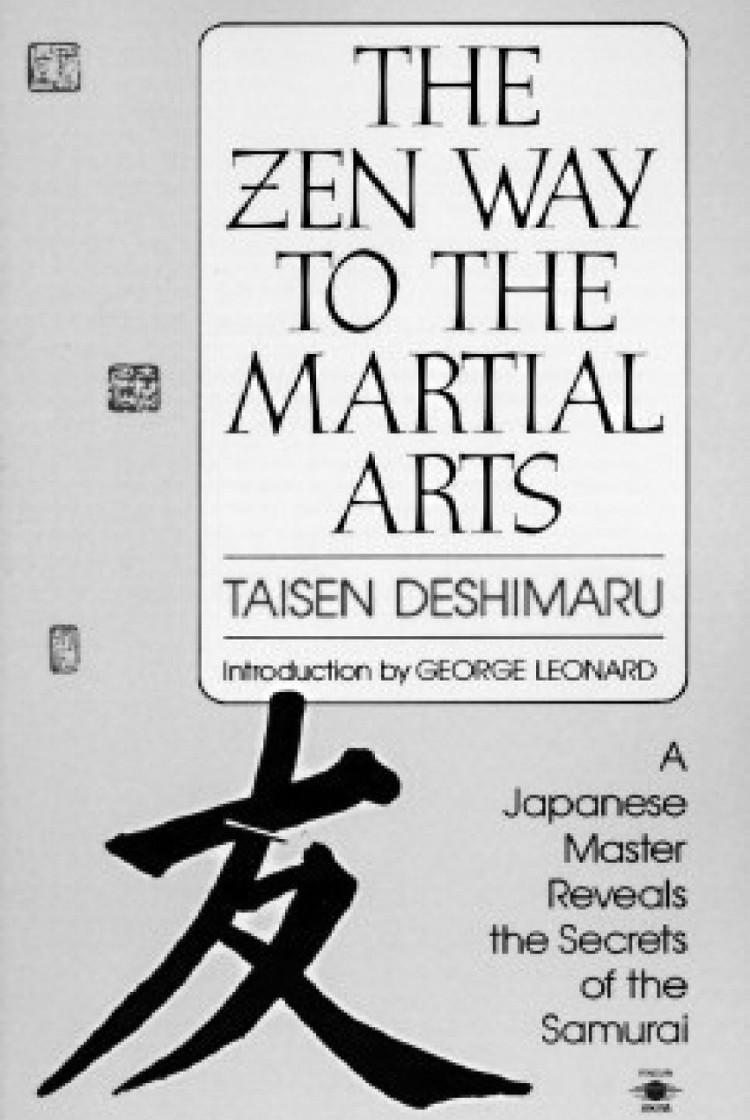
This is the Deshimaru book that reached the widest audience, and for a generation of Western martial artists it was the first serious suggestion that what they were doing had a spiritual dimension that was not decoration.
Published in French as Zen et arts martiaux in 1977, it appeared in English from Dutton in 1982, translated by Nancy Amphoux with an introduction by George Leonard, and has circulated since in Arkana, Compass and Penguin editions at around 120 pages. It mixes lessons, question-and-answer exchanges and koans, and it addresses practitioners of kendo, aikido, iaido, judo and archery directly, though it works for readers who have never entered a dojo.
Deshimaru came to the subject with standing. He grew up in Saga, a city with a strong samurai inheritance, raised in part by a grandfather who had been a samurai before the Meiji Restoration, and he practised kendo to a high level in his youth. When he writes about what happens in the body at the moment of a strike, he is not theorising.
His central arguments cut against most of what a Western student absorbs from a competitive training hall. Martial arts are not about defeating an opponent, and victory is at best a side effect of something else. The moment they become sport, organised around competition and championships, they turn into their opposite. He makes the linguistic case that the character bu, in budo and bushido, carries the sense of halting the spears, so that these are ways of stopping conflict rather than of conducting it. He works through bunbu ryōdō, the old ideal of mastering both the sword and the brush, as a model of wholeness rather than a curriculum.
Underneath the discussion of technique is his usual insistence on breath. Strength lies in the exhalation, not in the puffed chest of the inhale. The centre of gravity belongs low in the belly. Attention rests in the body rather than in the head deciding what to do next, because the interval in which the head decides is the interval in which you are already too late. Technique has to be mastered thoroughly and then abandoned, and the abandoning is the part no amount of training hours produces by itself.
Leonard's introduction does useful work for readers coming from the martial arts side, setting out how Zen and bushido met historically and why a practice as bare as zazen suited people who might die in the next exchange.
The book is short and dense with images and stories, which is why it gets reread rather than shelved. For anyone who watched the kendo and aikido sequences in the Desjardins films and wanted the argument laid out properly, this is where Deshimaru makes it at length.